What will be the order of new heap created after union of heap H1 and H2 when created by the following code. Initially both are of the order n.
FIB_UNION(H1,H2)
 {
  H =MAKE_HEAP()
  min[H]= min[H1]
  concatenate the root list of H2 with the root list of H
  if (min[H1] = NIL) or (min[H2]!= NIL and min[H2] < min[H1])
  then min[H] = min[H2]
  n[H]=  n[H1] + n[H2]
  free the objects H1 and H2
  return H
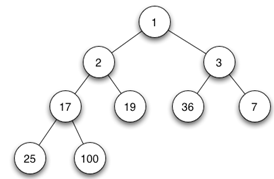
}If we implement heap as min-heap , deleting root node (value 1)from the heap. What would be the value of root node after second iteration if leaf node (value 100) is chosen to replace the root at start.
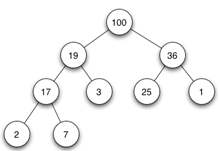
If we implement heap as maximum heap , adding a new node of value 15 to the left most node of right subtree . What value will be at leaf nodes of the right subtree of the heap.
Why is heap implemented using array representations than tree(linked list) representations though both tree representations and heaps have same complexities?
for binary heap
-insert: O(log n)
-delete min: O(log n)
for a tree
-insert: O(log n)
-delete: O(log n)
Then why go with array representation when both are having same values ?