Consider the pushdown automaton (PDA) below which runs over the input alphabet (a, b, c). It has the stack alphabet {Z0, X} where Z0 is the bottom-of-stack marker. The set of states of the PDA is (s, t, u, f} where s is the start state and f is the final state. The PDA accepts by final state. The transitions of the PDA given below are depicted in a standard manner. For example, the transition (s, b, X) → (t, XZ0) means that if the PDA is in state s and the symbol on the top of the stack is X, then it can read b from the input and move to state t after popping the top of stack and pushing the symbols Z0 and X (in that order) on the stack.
(s, a, Z0) → (s, XXZ0)
(s, ϵ, Z0) → (f, ϵ)
(s, a, X) → (s, XXX)
(s, b, X) → (t, ϵ)
(t, b, X) → (t,.ϵ)
(t, c, X) → (u, ϵ)
(u, c, X) → (u, ϵ)
(u, ϵ, Z0) → (f, ϵ)
The language accepted by the PDA is
PDA is more powerful than
PDA can be represented with the help of
Which of the following statement is false?
A push down automata is different than finite automata by
The instantaneous description is PDA shows
The symbol Z0 in formal definition of PDA is used for
The language accepted by a Pushdown Automation in which the stack is limited to 10 items is best described as
Which of the following statements is true?
Consider the NPDA 〈Q = {q0, q1, q2}, Σ = {0, 1}, Γ = {0, 1, ⊥}, δ, q0, ⊥, F = {q2}〉, where (as per usual convention) Q is the set of states, Σ is the input alphabet, Γ is stack alphabet, δ is the state transition function, q0 is the initial state, ⊥ is the initial stack symbol, and F is the set of accepting states, The state transition is as following
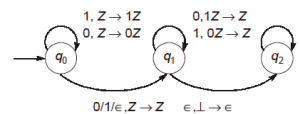
Which one of the following sequences must follow the string 101100 so that the overall string is accepted by the automaton?
Which of the following languages are context-free?
L1 = {ambnanbm ⎪ m, n ≥ 1}
L2 = {ambnambn ⎪ m, n ≥ 1}
L3 = {ambn ⎪ m = 2n + 1}